 Merken
 There's something almost meditative about watching miso soup come together on a quiet morning. I discovered this version during a particularly hectic week when I needed something that felt both nourishing and uncomplicated, a bowl of warmth that wouldn't demand much from me beyond attention. The silky tofu, the gentle bitterness of spinach, and that umami-rich broth became my anchor, something I'd return to whenever the kitchen felt like the only calm place in my day.
I made this for my neighbor one winter evening after she'd mentioned craving something Japanese but being too tired to navigate a complicated recipe. Watching her face soften as she took that first spoonful, seeing her shoulders drop just a little, reminded me that sometimes the simplest dishes carry the most weight. She asked for the recipe that night, and now it's her go-to when she needs to feel grounded.
Ingredients
- Dashi stock (4 cups): The foundation of everything here, whether you use kombu-based for vegetarian or traditional fish stock, it's what gives this soup its soul and subtle depth.
- White or yellow miso paste (3 tablespoons): The secret ingredient that transforms simple broth into something complex and deeply satisfying, though don't be tempted to add it straight to boiling water or it'll lose its magic.
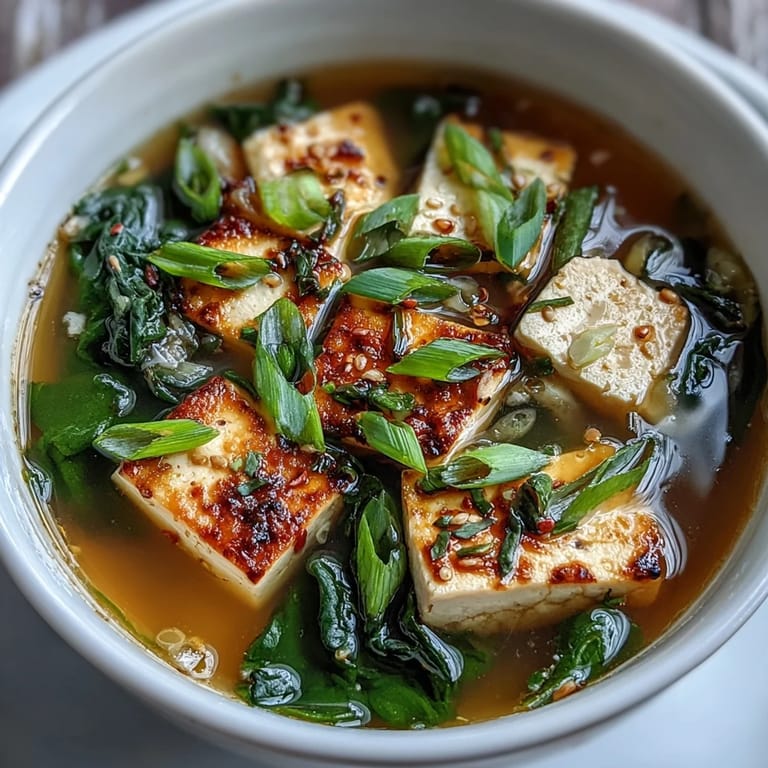
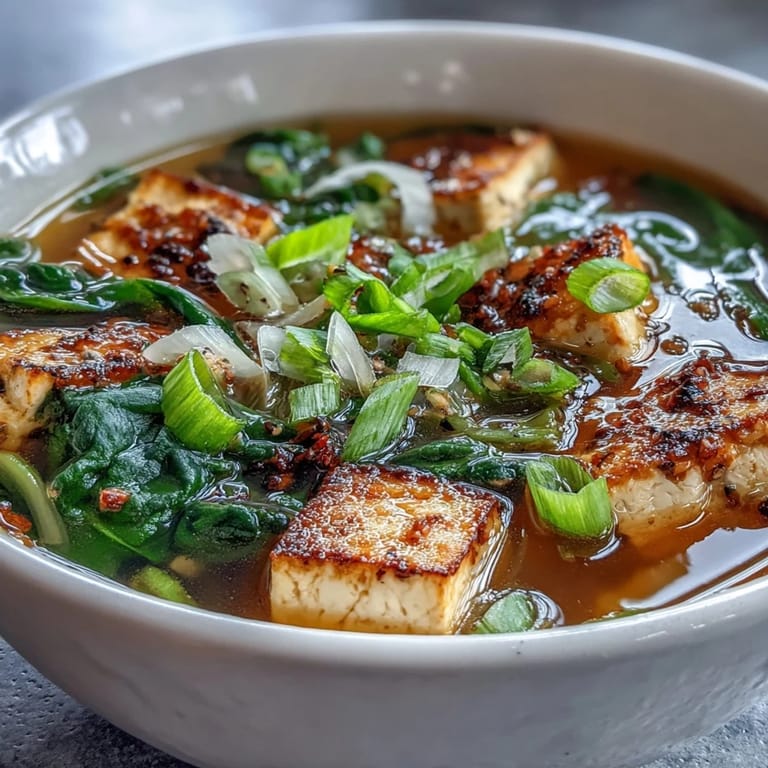
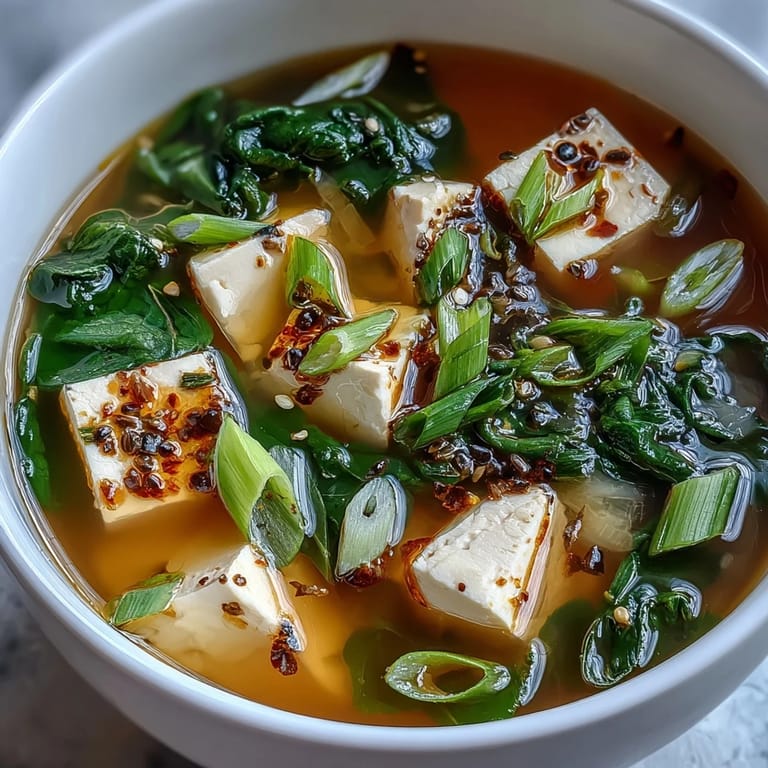
- Firm tofu (120 g, cut into 1/2-inch cubes): Delicate enough to absorb the broth's flavor while sturdy enough to hold its shape, creating those little pockets of creaminess in each spoonful.
- Fresh spinach leaves (2 cups, roughly chopped): Adds a subtle earthiness and color that brightens the bowl, wilting down to almost nothing but leaving its bright presence behind.
- Green onions (2, thinly sliced): The final flourish that brings everything to life with a sharp, fresh note right at the end.
Tired of Takeout? 🥡
Get 10 meals you can make faster than delivery arrives. Seriously.
One email. No spam. Unsubscribe anytime.
Instructions
- Bring the dashi to life:
- Pour your dashi into a medium saucepan and bring it to a gentle simmer over medium heat, letting the broth warm through without rushing. You'll know it's ready when small wisps of steam rise from the surface and the first quiet bubbles appear around the edges.
- Dissolve the miso properly:
- Spoon the miso paste into a small bowl and ladle about 1/2 cup of that hot dashi over it, then whisk gently until it's completely smooth and silky with no lumps hiding at the bottom. This step matters because miso is delicate and breaks down when boiled, so dissolving it separately keeps all those complex flavors intact.
- Add the tofu gently:
- Slide the tofu cubes into the saucepan and let them simmer for 2 to 3 minutes until they're heated all the way through, moving slowly to avoid breaking them apart.
- Wilt in the spinach:
- Stir in the chopped spinach and watch it transform from a pile of leaves into something silky in just 1 to 2 minutes, then take the pot off the heat before it loses its vibrant green.
- Finish with the green onions:
- Scatter the sliced green onions across the top and stir them through gently, letting their sharp freshness cut through all that savory depth you've built up.
- Serve immediately:
- Ladle the soup into bowls right away while it's still steaming, so every spoonful feels warm and alive.
 Merken
 This soup taught me that Japanese cooking isn't about complexity or showing off, it's about respecting each ingredient and letting it speak. I understood that evening with my neighbor when she thanked me, her hands wrapped around the warm bowl like it was a gift.
The Miso Paste Moment
The most important thing I've learned is that miso paste is alive with umami and doesn't need heat to show that off. The first time I added miso straight into boiling broth, it separated and became grainy, and I thought I'd ruined everything until I realized what I'd done wrong. Now I respect that small step of whisking it into room-temperature broth first, and the difference is night and day.
Building Flavor Without Fuss
There's a rhythm to this soup that reminds me why I keep coming back to it. You're never standing at the stove longer than a few minutes at a time, yet somehow all the components come together into something that feels both thoughtful and effortless. The tofu absorbs everything around it, the spinach adds earthiness, and those green onions arrive like a punctuation mark that says now it's complete.
Variations and Flexibility
Once you understand how this soup works, you can play with it without losing what makes it special. I've added thin mushroom slices before, let them soften in the broth for texture, and even experimented with a touch of sesame oil drizzled on top for depth. The core stays the same, but the canvas is yours to adjust based on what's in your kitchen or how adventurous you're feeling that day.
- Try mushrooms, wakame seaweed, or a dash of sesame oil to make it your own.
- Adjust the miso quantity to taste, adding more if you want deeper savory notes or less if you prefer something subtle.
- For a vegan version, just make sure your dashi is kombu-based and you're set.
 Merken
 This soup has become my answer to questions I haven't even asked yet, a way to feed myself and others without overthinking it. Every time I make it, I remember that sometimes the most beautiful meals are the ones that ask the least from you but give back the most.
Antworten auf Rezeptfragen
- → Wie verhindere ich, dass die Suppe nach dem Hinzufügen des Miso kocht?
Das Miso sollte nur unter leichtem Erwärmen eingerührt werden, um die wertvollen Aromen und Fermente zu bewahren. Die Suppe nicht zum Kochen bringen, sondern bei niedriger Temperatur ziehen lassen.
- → Kann man die Suppe vegan zubereiten?
Ja, indem ein pflanzliches Dashi auf Kombu-Basis verwendet wird und auf alle tierischen Zutaten verzichtet wird.
- → Welche Varianten passen gut zu dieser Basis?
Zusätze wie Wakame-Algen, Shiitake-Pilze oder ein Schuss Sesamöl verleihen der Suppe zusätzliche Tiefe und Textur.
- → Wie wird der Tofu am besten vorbereitet?
Fester Tofu wird in gleichmäßige Würfel geschnitten und kurz in der heißen Suppe erwärmt, damit er seine Form behält.
- → Welche Nährwerte hat diese Suppe?
Pro Portion enthält die Suppe etwa 75 Kalorien, 3 g Fett, 6 g Kohlenhydrate und 6 g Protein, ideal für eine leichte Mahlzeit.